Fotografato nell'Artico un iceberg a forma di rettangolo che sembra disegnato col righello

Icebridge-2.jpg

Una serie di fotografie scattate a inizio mese dalla divisione di ricerca sulla criosfera della NASA (NASA Ice) nei pressi della Piattaforma di ghiaccio Larsen ha suscitato molto stupore. Le immagini ritraggono, infatti, un iceberg di forma perfettamente rettangolare.

Per quanto la forma dell’iceberg-montagna sia talmente radicata nel nostro immaginario da diventare un metro di paragone, gli iceberg tabulari (di cui quello immortalato dagli studiosi della NASA fa parte) sono i più comuni. Questi ultimi, infatti, si formano dividendosi dalla banchisa artica quando quest’ultima diventa troppo fragile. Nel 2017 se ne è formato uno che raggiungeva più o meno le dimensioni della Liguria.

Le fotografie dell’iceberg rettangolare sono state scattate dalla NASA nell’ambito dell’operazione IceBridge . Cioè un’ampia indagine dell’agenzia governativa statunitense sulle calotte polari, sulle piattaforme di ghiaccio e sul ghiaccio marino. (via Colossal)

Icebridge.jpg
Icebridge-3.jpg

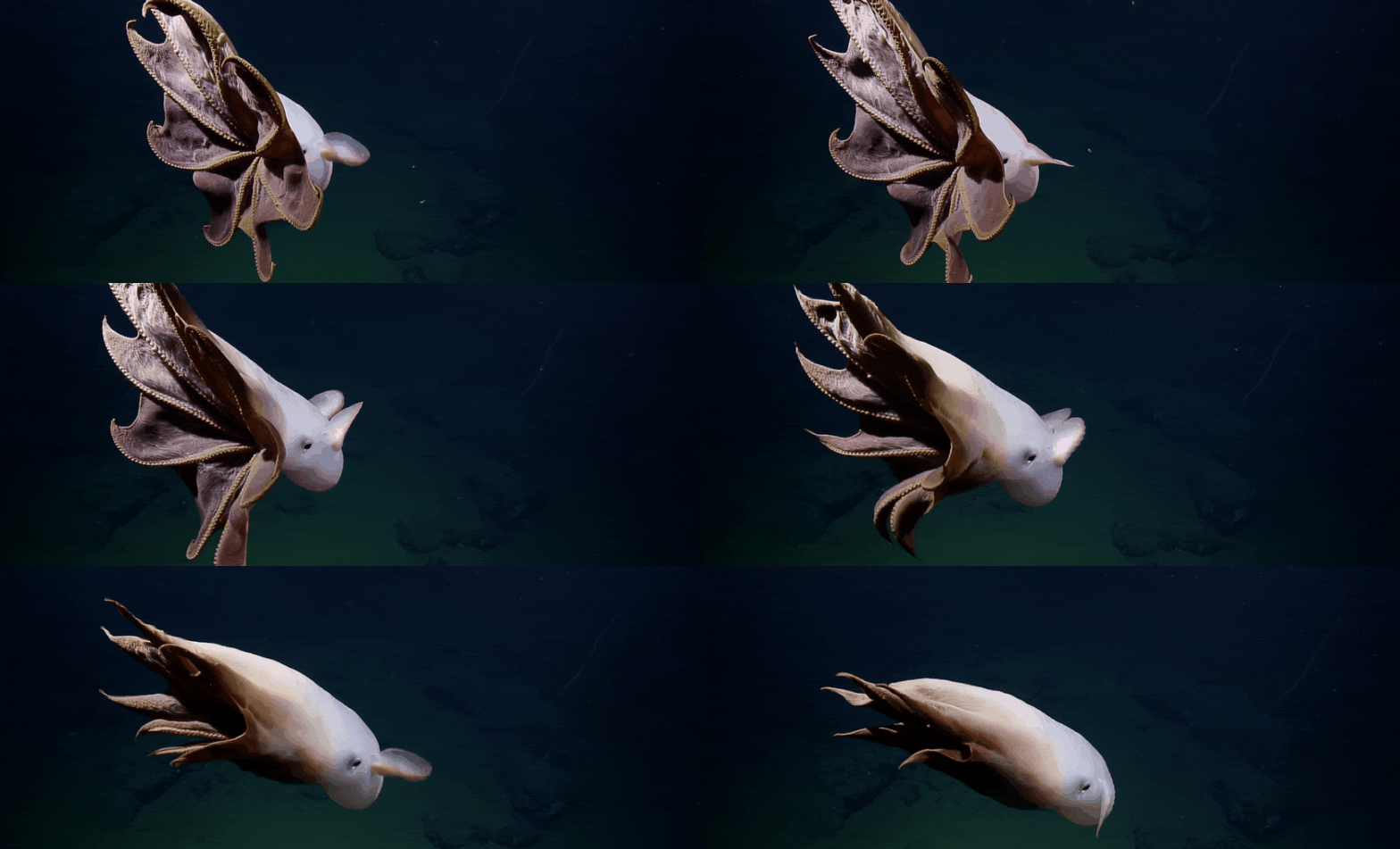
EV Nautilus ha filmato un adorabile polipo Dumbo che nuota negli abissi oceanici. Le immagini sono una rarità

dumbo-ocky_1024.gif

Delle straordinarie creature che popolano gli abissi oceanici e che gli scienziati della nave E\V Nautilus stanno rendendo familiari in tutto il mondo ho già parlato. Adesso un nuovo e adorabile personaggio si è andato ad aggiungere alla videoteca del team diretto dal ex ufficiale della marina degli Stati Uniti e professore di oceanografia Robert Ballard.

Si tratta di un Polpo Dumbo (Grimpoteuthis) che nuota aggraziato e leggero come una ballerina a oltre 3 chilometri di profondità.

Le immagini del simpatico cefalopode sono molto rare e fino a pochi anni fa non sarebbe stato possibile fare riprese così dettagliate di questa strana creatura. L’EV Nautilus, infatti, si serve di veicoli sottomarini comandati a distanza come il ROV Hercules per calarsi a profondità difficilmente accessibili all’uomo ed cattura fotogrammi ad alta risoluzione.

Il Polipo Dumbo si chiama come il famoso personaggio della Disney perchè le sue pinne stanno sopra agli occhi (per altro ciechi, secondo gli studiosi) e ricordano le orecchie di un elefantino. Spesso l’animaletto ha coloro vivaci e difficilmente misura più di 20-30 centimentri (quello nelle riprese però raggiungeva i 60) anche se l’esemplare più grande osservato arrivava addirittura a un metro e 80.

Le riprese del Polpo Dumbo sono state fatte nel corso dell’esplorazione che l’EV Nautilus stà svolgendo nel Davidson Seamount, un vulcano sottomarino inattivo nel Santuario Naturale della Baia di Monterey (California).

Lì gli scienziati hanno potuto vedere anche la più grande nursery di polipi del mondo (specie Muusoctopus robustus) dove centinaia e centinaia di questi animali proteggevano le loro uova. Anche di questo hanno fatto un video che allego in coda a questo post. (via sciencealert)

At first this ghostly octopus drifted past the camera on ROV Hercules flapping wing-like fins, then inverted its webbed arms, ballooning out to reveal eight rows of suckers. This rarely-seen Grimpoteuthis sp., commonly known as an umbrella octopus, was approximately 60cm (almost two feet) long!
We observed over a thousand deep sea octopus (Muusoctopus robustus) while exploring Davidson Seamount with Monterey Bay National Marine Sanctuary. Never before seen in these massive aggregations, most female octopus were resting in a brooding posture, tucked into rocks with eight arms inverted covering their bodies and eggs.

‘Melting Memories’ di Refik Anodol è la prima installazione a mostrare come cervello evoca i ricordi. Dati alla mano

swish-2.gif

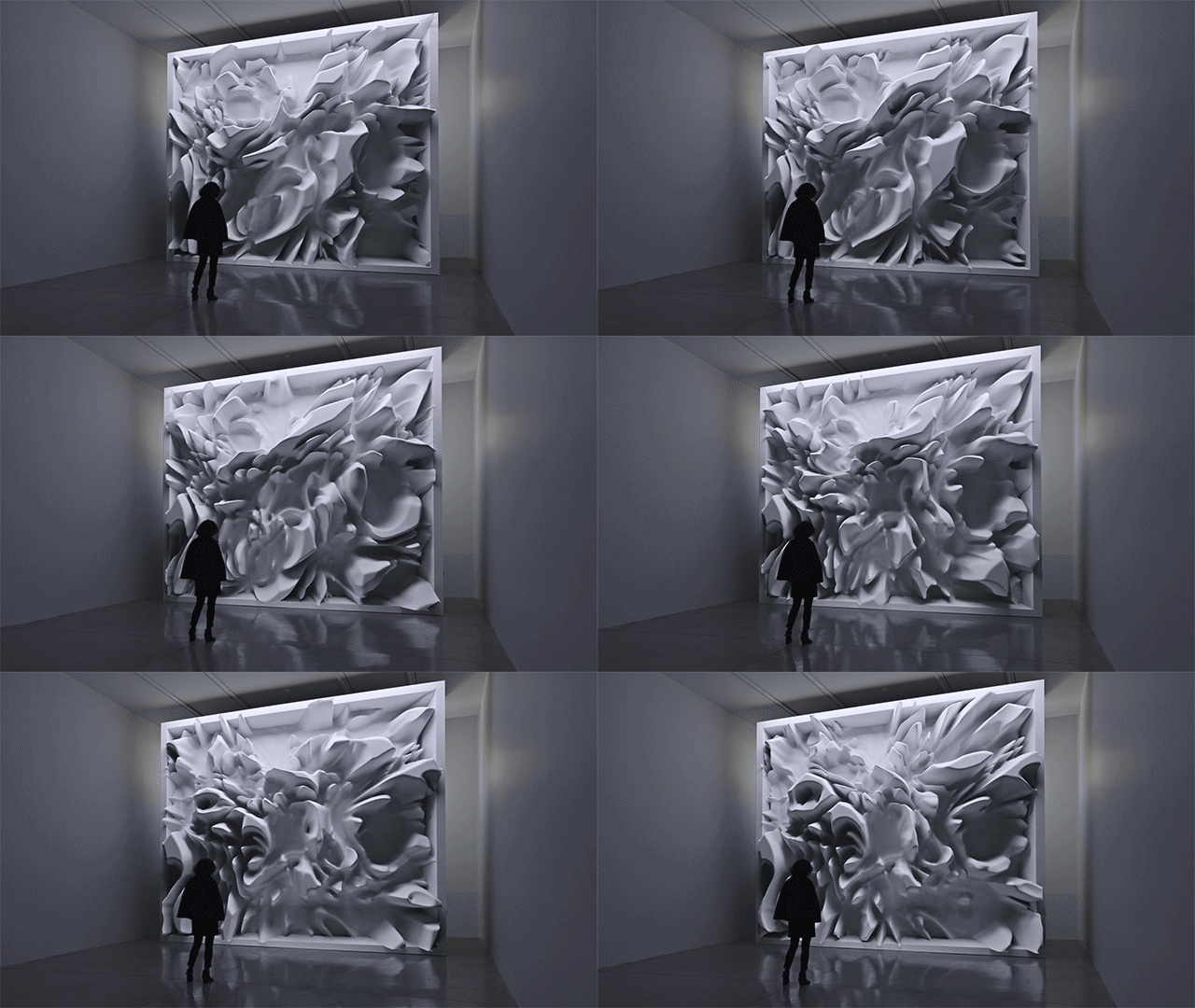
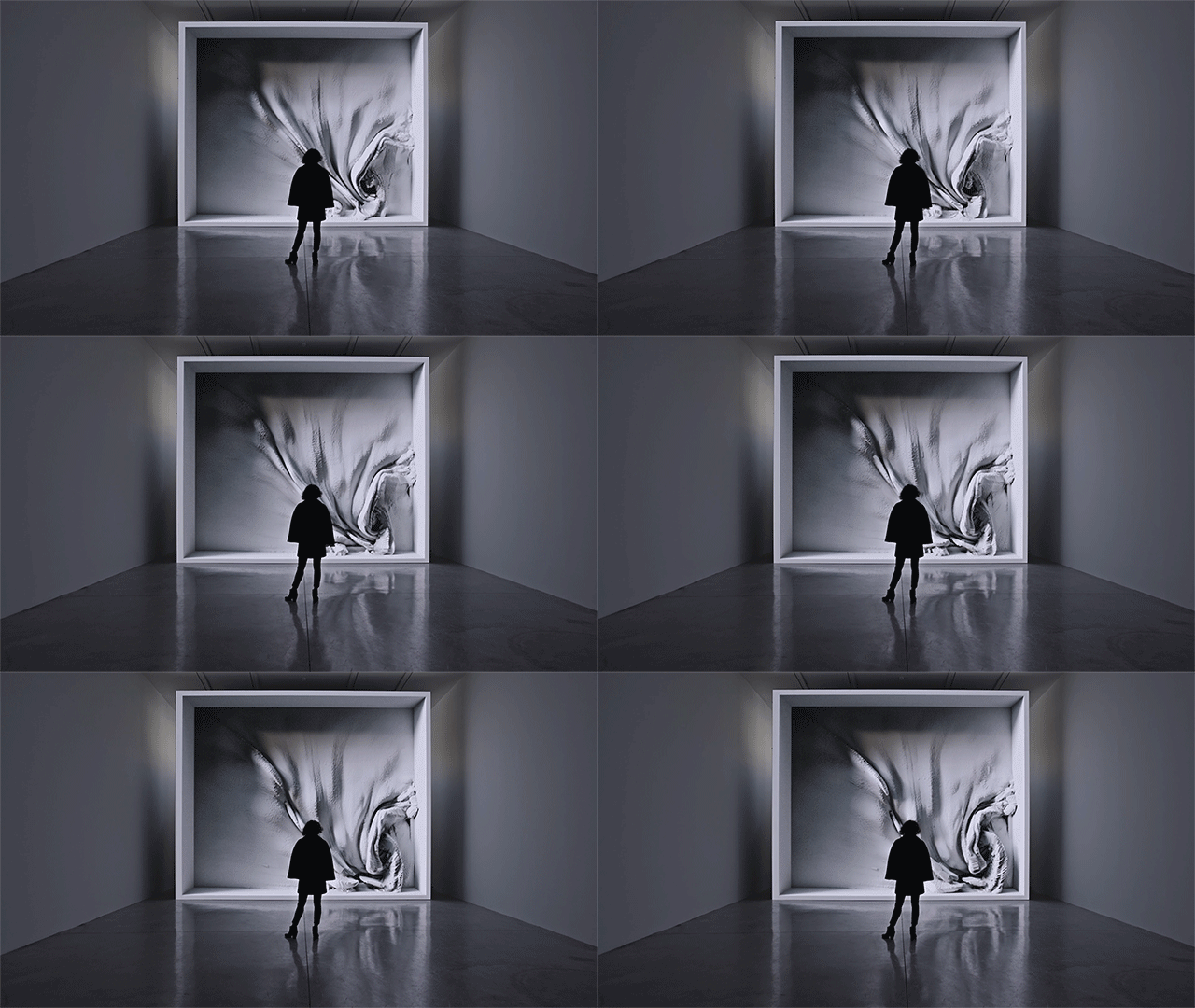
L’artista multimediale e designer di origini turche Refik Anadol ha fatto un lavoro monumentale per realizzare l’installazione ‘Melting Memories’. Perché l’opera, che si propone di mostrare come funziona il cervello nel tempo, non è di fantasia ma si basa sui dati degli elettroencefalogrammi.

Presentata nel 2018 alla Pilevneli Gallery di Istanbul, ‘Melting Memories’, già a vederla suscita stupore. E’ composta da un enorme schermo al LED (quasi 5 metri per 6) fatto su misura e da schiuma rigida fresata CNC. Per realizzarla, poi, Anadol ha combinato dipinti basati sui dati, proiezioni di luce e sculture poggiate sugli ‘augmented data’ (l’artista ha cioè aumentato il numero di immagini nel set di dati disponibili). 

Il risultato di tanta tecnologia combinata a una certa dose di rigore scientifico è morbido e cangiante. A momenti le forme che si creano sembrano fiori che sbocciano, poi montagne viste dall’alto, o nubi, onde e ghiacciai.

Per raccogliere i dati necessari a dare vita a questa incredibile installazione Refik Anadol ha condotto degli esperimenti al Laboratorio Neuroscape dell’Università della California (San Francisco). "Anadol raccoglie dati sui meccanismi neurali del controllo cognitivo da un EEG (elettroencefalogramma)- spiega il suo sito web- che misura i cambiamenti nell'attività delle onde cerebrali e fornisce le prove di come funziona il cervello nel tempo. Questi set di dati costituiscono gli elementi costitutivi degli algoritmi unici di cui l'artista ha bisogno per creare le strutture visive multidimensionali in mostra. "

Questa installazione parla di memoria e di come il nostro cervello si muove. Quindi in qualche modo anche di nostalgia e pensiero. Volendo persino di intelligenza artificiale. Anche se tutte le opere di Refik Anadol in fondo soprattutto esplorano la terra di confine tra realtà fisica e digitale. 

Per vedere altre opere di  Refik Anadol ci sono il suo sito web ma anche gli account Instagram, Vimeo e Behance. (via Colossal)

Engram : Data Sculpture 3+1 AP 6M x 5M Media Wall, 3MM LED, Custom Software Designed and developed at Refik Anadol Studio Sound Design : Kerim Karaoglu Custom Software : Kyle McLean _ From February 7 through March 17, 2018, Pilevneli Gallery presented Refik Anadol’s latest project on the materiality of remembering. Melting Memories offered new insights into the representational possibilities emerging from the intersection of advanced technology and contemporary art. By showcasing several interdisciplinary projects that translate the elusive process of memory retrieval into data collections, the exhibition immersed visitors in Anadol’s creative vision of “recollection.” “Science states meanings; art expresses them,” writes American philosopher John Dewey and draws a curious distinction between what he sees as the principal modes of communication in both disciplines. In Melting Memories, Refik Anadol’s expressive statements provide the viewer with revealing and contemplative artworks that will generate responses to Dewey’s thesis. Comprising data paintings, augmented data sculptures and light projections, the project as a whole debuts new advances in technology that enable visitors to experience aesthetic interpretations of motor movements inside a human brain. Each work grows out of the artist’s impressive experiments with the advanced technology tools provided by the Neuroscape Laboratory at the University of California, San Francisco. Neuroscape is a neuroscience center focusing on technology creation and scientific research on brain function of both healthy and impaired individuals. Anadol gathers data on the neural mechanisms of cognitive control from an EEG (electroencephalogram) that measures changes in brain wave activity and provides evidence of how the brain functions over time. These data sets constitute the building blocks for the unique algorithms that the artist needs for the multi-dimensional visual structures on display. Anadol’s installations do not only address a productive espousal of cutting-edge technology and art but also a strong preoccupation with the study of human memory from Ancient Egyptians to Blade Runner 2049. The exhibition’s title, Melting Memories, refers to the artist’s experience with unexpected interconnections among seminal philosophical works, academic inquiries and artworks that take memory as their principal themes. The title further draws attention to the melting of neuroscience and technology into these centuries-long philosophical debates, questioning the emergence of a new space where artificial intelligence is not in conflict with individuality and intimacy. _ PROCESS The data collection process utilized a 32-channel Enobio and standard protocol configuration. Participants were instructed to focus on specific childhood memories during the recording process. A control recording was also conducted to identify artifacts to later filter with adaptive notch filtering and limiting the frequency range. For analysis we focused on beta (13-17Hz) and theta (3-7Hz) channels, isolating activation points corresponding to short term and long-term (specifically episodic) memory. Our selections were the Fp1, Fp2, F7, F8, P3, P4, C3, C4, T7, T8, O1, and O2 nodes, which were also used to drive noise parameters within the real-time simulation. For scaling we applied Higuchi’s fractal dimension algorithm and used FFT for a moving average. Recurrent neural nets (via EEGLearn) we used on the recording sessions to generate spectral outputs, which were then utilized as height maps for the visual representation pipeline. _ Bashivan, et al. "Learning Representations from EEG with Deep Recurrent-Convolutional Neural Networks." International conference on learning representations (2016) Transposing EEG data in to procedural noise forms was a really engaging challenge, both technically and conceptually. In the input data and our mapped representation you can find recurrence and rhythm but also hints of higher dimensional structures. We wanted to do this efficiently and in real time and so working on Melting Memories dovetailed nicely with putting the last touches on FieldTrip, an (at the time pre-release) open source GPU library for HLSL/vvvv. It allowed us to use a composite design pattern to very quickly iterate while producing the aesthetic structures used in the project. This approach enabled us to really explore some deeper procedural functions whilst keeping a completely modular graphics pipeline. This modularity makes it easy and clean to expand on the project’s abstracted content in really interesting ways, such as further integration of machine learning on the source data, evolving rendering techniques and the creation of sculpted physical artifacts. For more information: http://refikanadol.com/works/melting-memories/
swish-1.gif